
Call for Papers : The 10th International Conference on Algorithms, Computing and Systems (ICACS 2026)
Publish : Tuesday 27 October 2026 By Patcharee Chaiyong จำนวนผู้เข้าชม 7 คน
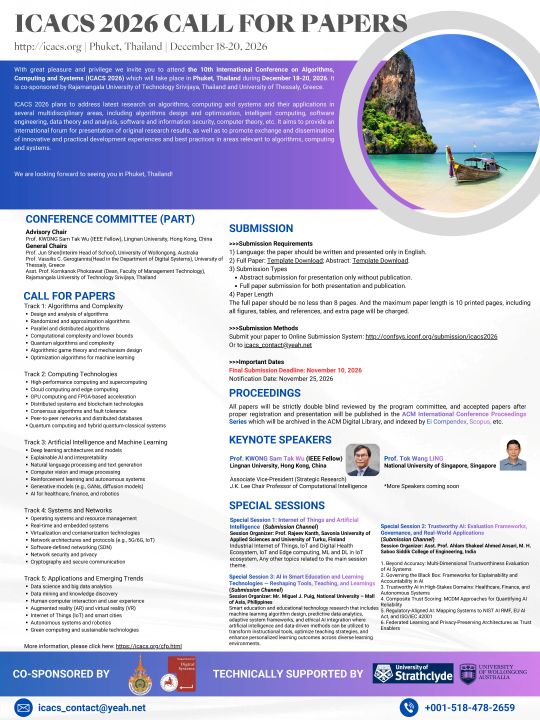
ICACS 2026 CALL FOR PAPERS
http://icacs.org | Phuket, Thailand | December 18-20, 2026
With great pleasure and privilege we invite you to attend the 10th International Conference on Algorithms, Computing and Systems (ICACS 2026) which will take place in Phuket, Thailand during December 18-20, 2026. It is co-sponsored by Rajamangala University of Technology Srivijaya, Thailand and University of Thessaly, Greece. ICACS 2026 plans to address latest research on algorithms, computing and systems and their applications in several multidisciplinary areas, including algorithms design and optimization, intelligent computing, software engineering, data theory and analysis, software and information security, computer theory, etc. It aims to provide an international forum for presentation of original research results, as well as to promote exchange and dissemination of innovative and practical development experiences and best practices in areas relevant to algorithms, computing and systems.
We are looking forward to seeing you in Phuket, Thailand!
Topics of interest (https://www.icacs.org/cfp.html)
Papers in the main technical program must describe high-quality, original research. Topics of interest include all aspects of algorithms, computing and systems including, but not limited to
Track 1: Algorithms and Complexity
▪ Design and analysis of algorithms
▪ Randomized and approximation algorithms
▪ Parallel and distributed algorithms
▪ Computational complexity and lower bounds
▪ Quantum algorithms and complexity
▪ Algorithmic game theory and mechanism design
▪ Optimization algorithms for machine learning
▪ Online learning and reinforcement learning algorithms
▪ Federated learning and privacy-preserving algorithms ▪ Graph algorithms and network flows
▪ Combinatorial optimization and integer programming
▪ Dynamic programming and greedy algorithms
▪ Streaming algorithms and sublinear algorithms
▪ Computational geometry and topology
▪ Bioinformatics algorithms and computational biology
▪ Cryptographic algorithms and protocols
▪ Approximation and online algorithms for scheduling
Track 2: Computing Technologies
▪ High-performance computing and supercomputing
▪ Cloud computing and edge computing
▪ GPU computing and FPGA-based acceleration
▪ Distributed systems and blockchain technologies
▪ Consensus algorithms and fault tolerance
▪ Peer-to-peer networks and distributed databases
▪ Quantum computing and hybrid quantum-classical systems
▪ Scalable computing architectures
▪ Serverless computing and microservices ▪ Energy-efficient computing and green IT
▪ In-memory computing and storage systems
▪ Mobile computing and ubiquitous systems
▪ Edge AI and on-device machine learning
▪ Computational storage and memory-centric computing
▪ Neuromorphic computing and brain-inspired architectures
▪ Reconfigurable computing and adaptive systems
▪ High-availability and fault-tolerant systems
Track 3: Artificial Intelligence and Machine Learning
▪ Deep learning architectures and models
▪ Explainable AI and interpretability
▪ Natural language processing and text generation
▪ Computer vision and image processing
▪ Reinforcement learning and autonomous systems
▪ Generative models (e.g., GANs, diffusion models)
▪ AI for healthcare, finance, and robotics ▪ Multimodal AI systems and applications
▪ Transfer learning and domain adaptation
▪ Self-supervised and unsupervised learning
▪ Federated learning and decentralized AI
▪ AI-powered recommendation systems
▪ AI for cybersecurity and anomaly detection
Track 4: Systems and Networks
▪ Operating systems and resource management
▪ Real-time and embedded systems
▪ Virtualization and containerization technologies
▪ Network architectures and protocols (e.g., 5G/6G, IoT)
▪ Software-defined networking (SDN)
▪ Network security and privacy
▪ Cryptography and secure communication
▪ Intrusion detection and prevention systems
▪ Privacy-preserving technologies (e.g., differential privacy) ▪ Internet of Things (IoT) and edge networking
▪ Wireless and mobile networks
▪ Network function virtualization (NFV)
▪ Content delivery networks (CDNs)
▪ Network performance optimization and QoS
▪ Blockchain and decentralized network systems
▪ Cyber-physical systems and industrial IoT
▪ Network simulation and modeling tools
▪ Next-generation internet architectures
Track 5: Applications and Emerging Trends
▪ Data science and big data analytics
▪ Data mining and knowledge discovery
▪ Human-computer interaction and user experience
▪ Augmented reality (AR) and virtual reality (VR)
▪ Internet of Things (IoT) and smart cities
▪ Autonomous systems and robotics
▪ Green computing and sustainable technologies
▪ Wearable computing and ubiquitous systems
▪ Digital twins and simulation-based optimization
▪ Emerging applications in healthcare, education, and industry ▪ Computational social science and digital humanities
▪ Smart agriculture and precision farming
▪ AI-driven climate modeling and environmental monitoring
▪ Fintech and blockchain applications
▪ E-governance and smart public services
▪ Personalized medicine and healthcare analytics
▪ Educational technology and AI in learning
▪ Entertainment computing and gaming technologies
▪ Disaster management and emergency response systems
Special Sessions (https://www.icacs.org/specialsession.html)
Special Session 1: Internet of Things and Artificial Intelligence
Session Organizer: Prof. Rajeev Kanth, Savonia University of Applied Sciences and University of Turku, Finland
Subtopics: Industrial Internet of Things, IoT and Digital Health Ecosystem, IoT and Edge computing, ML and DL in IoT ecosystem, Any other topics related to the main session theme.
Research Scope: IoT related research that includes IoT design, development, framework building, architectural research where Artificial intelligence can be utilized to perform insightful decision in any application domain of the development.
Submission Method: Submit your Full Paper (no less than 8 pages) or your paper abstract-without publication (200-400 words) via Online Submission System, then choose Special Session 1 (Internet of Things and Artificial Intelligence)
Template Download
Prof. Rajeev Kanth
Savonia University of Applied Sciences and University of Turku, Finland
Biography: Prof.(h.c.) Rajeev Kanth received a Doctor of Science (D.Sc.) in Information and Communication Technology from the University of Turku, Finland, in 2013. He has been working as a Principal Lecturer (Yliopettaja- in Finnish) at the Savonia University of Applied Sciences, Finland, where he focuses on teaching and research on the Internet of Things (IoT). He has been an Adjunct Professor at the Department of Computing, University of Turku, Finland, and an honorary Professor at Hebei University of Environmental Engineering, China. He is currently a senior member of the IEEE. Previously, he worked at the Indian Space Research Organization (ISRO), Ahmedabad, India, and the Royal Institute of Technology (KTH), Stockholm, Sweden, where he was a researcher and a senior research scientist, respectively. He has over 25 years of experience working in academic and research institutions. His current research interests include the Internet of Things, big-data analytics, artificial intelligence, and wireless cloud and edge computing. He has published more than 100 scientific articles in peer-reviewed conference proceedings and refereed computer science and communication technology journals. Some of the recent and ongoing research and development projects are UCNDRONE (funded by the Finnish Ministry of Education), VLEFACT (EU Erasmus Plus-funded project), and AIQUSEC (Business Finland).
Special Session 2: Trustworthy AI: Evaluation Frameworks, Governance, and Real-World Applications
Session Organizer: Asst. Prof. Ahlam Shakeel Ahmed Ansari, M. H. Saboo Siddik College of Engineering, India
Description: As AI systems become embedded in critical decision-making pipelines, evaluating their trustworthiness demands a rigorous, multidimensional lens that goes far beyond conventional performance metrics. This special session invites original contributions exploring composite trust scoring, explainability, fairness, robustness, and regulatory alignment across AI paradigms. We welcome papers that bridge theoretical frameworks with applied deployments — particularly in healthcare, finance, and autonomous systems — contributing to the global conversation on accountable and auditable AI.
The topics of interest include, but are not limited to:
1. Beyond Accuracy: Multi-Dimensional Trustworthiness Evaluation of AI Systems
2. Governing the Black Box: Frameworks for Explainability and Accountability in AI
3. Trustworthy AI in High-Stakes Domains: Healthcare, Finance, and Autonomous Systems
4. Composite Trust Scoring: MCDM Approaches for Quantifying AI Reliability
5. Regulatory-Aligned AI: Mapping Systems to NIST AI RMF, EU AI Act, and ISO/IEC 42001
6. Federated Learning and Privacy-Preserving Architectures as Trust Enablers
Submission Method: Submit your Full Paper (no less than 8 pages) or your paper abstract-without publication (200-400 words) via Online Submission System, then choose Special Session 2 (Trustworthy AI: Evaluation Frameworks, Governance, and Real-World Applications)
Asst. Prof. Ahlam Shakeel Ahmed Ansari
M. H. Saboo Siddik College of Engineering, India
Biography: Ahlam Shakeel Ahmed Ansari is an Assistant Professor of Computer Engineering at M. H. Saboo Siddik College of Engineering, Mumbai, with over 16 years of teaching and research experience. She is is researching — "A Unified Framework for Evaluating Trustworthiness of AI Systems (UFE-TAIS)" — develops a paradigm-aware composite trustworthiness scoring pipeline anchored to the NIST AI RMF, EU AI Act, and ISO/IEC 42001. Her research spans trustworthy AI evaluation, federated learning, privacy-preserving AI, AI governance, and MCDM (BWM-TOPSIS) methodologies, with applications in healthcare and cybersecurity. She holds 20+ publications and credentials, including Google Certified Educator (Levels 1, 2 & Gemini), Mendeley Advisor, SciSpace Ambassador, and MIT JWEL membership.
Special Session 3: AI in Smart Education and Learning Technologies — Reshaping Tools, Teaching, and Learnings
Session Organizer: Mr. Miguel J. Puig, National University – Mall of Asia, Philippines
Subtopics: Machine Learning and Predictive Analytics in Smart Learning Environments, AI-Assisted Assessment and Automated Feedback Systems, Ethical AI Frameworks and Bias Mitigation in Educational Technology, Pattern Recognition in Special Education and Learning Behavior Analysis, Personalized and Adaptive Learning Algorithms, Human-in-the-Loop AI for Innovative Pedagogical Methods, Any other topics related to the main session theme.
Research Scope: Smart education and educational technology research that includes machine learning algorithm design, predictive data analytics, adaptive system frameworks, and ethical AI integration where artificial intelligence and data-driven methods can be utilized to transform instructional tools, optimize teaching strategies, and enhance personalized learning outcomes across diverse learning environments.
Submission Method: Submit your Full Paper (no less than 8 pages) or your paper abstract-without publication (200-400 words) via Online Submission System, then choose Special Session 3 (AI in Smart Education and Learning Technologies — Reshaping Tools, Teaching, and Learnings)
Mr. Miguel J. Puig
National University – Mall of Asia, Philippines
Biography: Miguel J. Puig is currently a Professor at the School of Information Technology, National University (NU) – Mall of Asia, Philippines. Mr. Puig is an active member of the Philippine Society of Information Technology Educators (PSITE) and serves as a technical peer reviewer for international academic conferences, His primary research specializations center on Data Science, Machine Learning, and Algorithmic Design, with a dedicated focus on AI in smart education, learning behavior pattern analysis (including special education for students with autism), ethical AI integration, and educational data analytics. In addition to his academic research, he brings extensive hands-on experience in software engineering, system architecture, and applied database systems.
SUBMISSION
Submission Requirements
1) Language: the paper should be written and presented only in English.
2) Full Paper: Template Download; Abstract: Template Download.
3) Submission Types
Abstract submission for presentation only without publication.
Full paper submission for both presentation and publication.
4) Paper Length
The full paper should be no less than 8 pages. And the maximum paper length is 10 printed pages, including
all figures, tables, and references, and extra page will be charged.
Submission Methods
Submit your paper to Online Submission System: http://confsys.iconf.org/submission/icacs2026
Or to icacs_contact@yeah.net
Important Dates
Final Submission Deadline: November 10, 2026
Notification Date: November 25, 2026
PROCEEDINGS : All papers will be strictly double blind reviewed by the program committee, and accepted papers after
proper registration and presentation will be published in the ACM International Conference Proceedings Series
which will be archived in the ACM Digital Library, and indexed by Ei Compendex, Scopus, etc.
Contact
Website : https://www.icacs.org/index.html
Secretary: Ms. Joie Wu Email: icacs_contact@yeah.net
- Call for Papers on Electrical Engineering/Electronics,...
- Call for Papers : The 10th International Conference on...
- CALL FOR PAPERS : 2027 The 15th International Electrical...
- การประชุมวิชาการระดับชาติ สมาคมนักเทคโนโลยีครั้งที่ 3...
- The 23rd KU KPS National Conference
- ขอเชิญร่วมส่งผลงาน มหกรรมแสดงผลงานระดับชาติบุคลากรสายสนั...
ออกแบบและพัฒนาโดย สำนักวิทยบริการและเทคโนโลยีสารสนเทศ มหาวิทยาลัยเทคโนโลยีราชมงคลล้านนา